Programme
Edward Elgar – Violin Concerto in B minor, Op. 61
- Allegro
- Andante
- Allegro molto
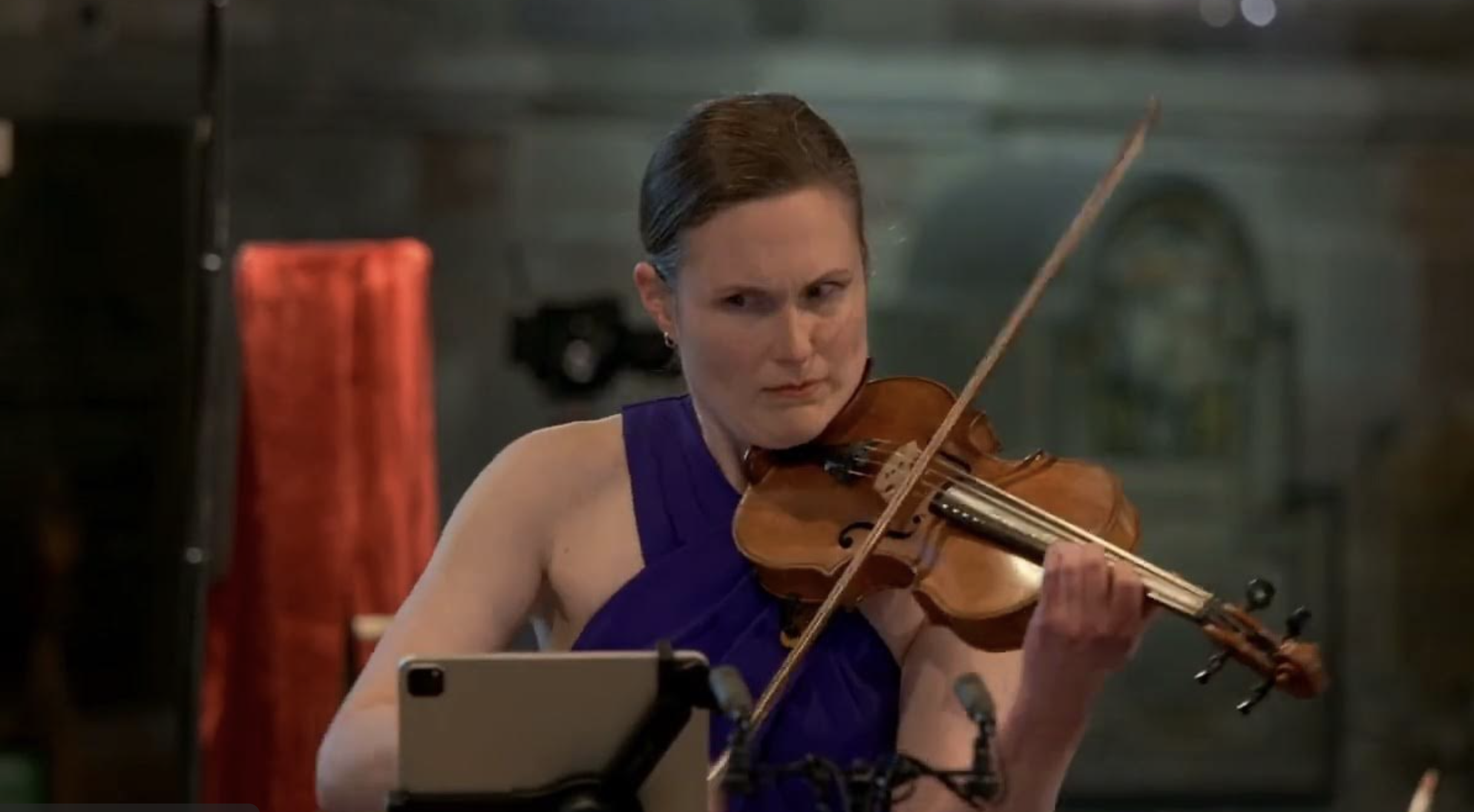
Zoë Beyers – violin
English Symphony Orchestra
Kenneth Woods – conductor
Filmed live at the 2024 Elgar Festival in Worcester Cathedral
Video and audio recording and editing by Tim Burton
EDWARD ELGAR: VIOLIN CONCERTO, OP.61 (1910)
- Allegro
- Andante
- Allegro molto
Only eight years separate the Violin Concerto (written in 1910) from the Violin Sonata (written in 1918), but those years were, of course, some of the most turbulent in history. Elgar was deeply affected by World War One, and could even hear the sound of artillery in France from his home in Brinkwells while writing the Violin Sonata, but he was also haunted in these years by a sense of life and history leaving him behind. In the years between the Violin Concerto and the Violin Sonata, he’d gone from being one of the two or three most celebrated modernist composers in the world to being regarded, perhaps even in his own eyes, as something of an anachronism. And, with his own wife’s health beginning to fail, he was becoming ever more conscious of entering the final chapters of his own life.
A superficial look at Elgar’s Violin Concerto might lead one to conclude that it is yet another typical example of post-Romantic excess, along the lines of Mahler’s Eighth Symphony or Strauss’s Ein Heldenleben. But, just as the enormity those works by Mahler and Strauss belies their more personal subtexts, Elgar’s Violin Concerto, for all its grandeur and virtuosity, is one of his most personal, even private, statements.
Elgar had considered writing a violin concerto as early as 1890, but it was not util Fritz Kreisler first asked for a concerto in 1907 that Elgar began to pursue the idea in earnest. Kreisler had come to admire Elgar enormously through the Dream of Gerontius. His enthusiasm was typical of a generation of European musicians like Richard Strauss and Hans Richter, who were quick to recognise Elgar’s importance. Kreisler had said of Elgar:
“If you want to know whom I consider to be the greatest living composer, I say without hesitation Elgar… I say this to please no one; it is my own conviction… I place him on an equal footing with my idols, Beethoven and Brahms. He is of the same aristocratic family. His invention, his orchestration, his harmony, his grandeur, it is wonderful. And it is all pure, unaffected music. I wish Elgar would write something for the violin.”
The Royal Philharmonic Society formally commissioned the work in 1909. In spite of his intimate knowledge of the violin, Elgar worked closely with the newly-appointed Leader of the London Symphony Orchestram W. H. “Billy” Reed, a man who would become one of Elgar’s closest friends, on the violin writing. Kreisler also offered suggestions. The result was a work of unprecedented virtuosity. The violin part is itself almost orchestral, with the soloist playing whole passages in double and triple stops. The work is also a striking monument to a musician at the absolute peak of his craft as both a composer and conductor. With Gerontius, the Enigma Variations and the First Symphony under his belt, Elgar had developed a level of understanding of orchestration and performance practise that remains perhaps unsurpassed even today. The Violin Concerto is thus perhaps unique not only in its scale but in the density of its working out – there is a tempo change in almost every bar, and an expressive marking on almost every note.
The premiere was at a Royal Philharmonic Society concert on 10 November 1910, with Kreisler and the London Symphony Orchestra conducted by the composer. Reed recalled, “the Concerto proved to be a complete triumph, the concert a brilliant and unforgettable occasion.” It was to be the last great public success of his career. When Elgar’s Second Symphony was premiered just a year later, it met a dismal reception.
Behind the Concerto’s monumental façade, however, lay a more private and enigmatic story. On the first page of ths score, Elgar placed a Spanish epigraph “Aquií está encerrda el alma de…..”, which Elgar himself translated in a letter as “Here, or more emphatically In here is enshrined or (simply) enclosed – buried is perhaps too definite – the soul of? the final ‘de’ leaves it indefinite as to sex or rather gender.” It was no typographical accident that the epigraph ended with five dots rather than the standard three. Elgar welcomed, even invited speculation as to the owner of “the soul of?”, continuing in one letter by saying “Now guess.”
Elgar, as was his wont with other “dark sayings,” never gave a definitive answer, but the most likely candidate was Alice Stuart-Wortley. The Elgars and the Stuart- Wortleys were family friends in the years before the composition of the Concerto, and Elgar, in order to avoid confusion with his wife who shared the same first name, had bestowed on Mrs. Stuart-Wortley the nickname “Windflower.” As the concerto developed, Elgar wrote to her, describing it as both “your concerto” and “our concerto”, describing several phrases as “Windflower themes.”
Other names have been suggested besides that of Alice Stuart-Wortley, including Elgar’s young love Helen Weaver and his best friend August Jaeger (“Nimrod” of the Enigma Variations). But often overlooked is the first part of the epigraph: “Here, or more emphatically In here.” The Concerto is not simply a portrait of ‘the soul of?’, it is a grand depiction of “In here.” It seems obvious that it is a depiction of Elgar’s own soul in which that of “……” has found a permanent place.
The work opens in symphonic tone with a long orchestral exposition. It introduces three main themes which will carry the listener through the work to come. The first is heard in the opening bars and is built mostly of wide leaps up and down, as if the music is being pulled in two different directions. The second, which Elgar called ‘dejection,’ is built mostly of sighing semitones. And, finally, there is the ‘Windflower’ theme itself, ascending gently in the major where ‘dejection’ falls inexorably in the minor.
After the high drama of the first movement, the second is more understated: a tender Andante rather than a brooding Adagio, which nevertheless hints at tensions hidden beneath the surface in its recurring use of Wagner’s “Tristan chord,” by then a well-known musical shorthand for tragic love.
It is the Finale which is the most original part of the work. Brahms and Beethoven had already expanded the concerto form long before Elgar, but they always left the weight of the musical argument in the first movement of their concertos, saving the finale for music that was generally lighter in character and tighter in construction. In this work, Elgar makes the finale the emotional centre of the work. It’s a big ask after the two previous movements, and Kreisler found in later performances that it was a mountain he could no longer climb, introducing cuts in his later performances and eventually declining Elgar’s initiation to record the work. Not only has Elgar moved the emotional centre of gravity to the finale, he has moved the cadenza, and in doing so changed the function of the cadenza from a moment of virtuoso display (often even left to the performer to improvise or compose themselves) to one of deep contemplation. Instead of the loud chord one normally hears before a cadenza, the orchestra barely breathes the violin to life with a magical sound Elgar called ‘thrumming’, a sort of pizzicato tremolo done with the flattened flesh of the fingers. The violin takes us on extended tour of Elgar’s soul, built almost entirely of those three themes which opened the work. In the end, he finishes not with ‘dejection’ or ‘Windflower’, but with the Janus-like melody with the rising and falling leaps which opened the work. And, as the orchestra comes in for the final pages, Elgar settles on a new course. Torn no longer between the life he had and the life he might have had, he ends with the theme of the Finale, one with only rises, and rises.
Zoë Beyers, violin
South-African born Zoë Beyers has established a reputation as one of the finest violinists based in the UK, and performs as soloist, chamber musician, director and orchestral leader across the world. Zoë’s remarkable versatility was nurtured by Gabrielle Lester and Felix Andrievsky at the Royal College of Music, where she was an ABRSM international scholarship holder, Yehudi Menuhin Scholar, winner of the Tagore Gold Medal, and winner of the UNISA String Competition in South Africa. Since her solo debut aged eleven with the Swedish Chamber Orchestra under Paavo Järvi, she has performed with many distinguished conductors worldwide. She currently features prominently as soloist with the English Symphony Orchestra on the ESO Digital platform, performing amongst others Weinberg’s Concertino and Milhaud’s Le boeuf sur le toit. She also performs as a soloist with the BBC Philharmonic, Royal Liverpool Philharmonic and the City of Birmingham Symphony Orchestra. In 2020, Zoë took up the position of Leader of the BBC Philharmonic Orchestra, with whom she appears regularly as a soloist and chamber musician.
Zoë is a member of the internationally renowned Hebrides Ensemble and also performs, broadcasts and records with the Nash Ensemble, Birmingham Contemporary Music Group, the Scottish Ensemble, and I Musicanti. In 2019 she joined the Dante Quartet as their first violinist. She has collaborated with Francois Leleux, Stephen Osborne, Lars Vogt, Elisabeth Leonskaja and Alexander Janiczek, and composers Helen Grime, Huw Watkins, Oliver Knussen, Sir Peter Maxwell Davies and Sir James Macmillan. Hebrides Ensemble’s 2017 recording of Maxwell Davies’s late chamber works (‘The Last Island’/Delphian), featured on BBC Radio 3 and attracted top ranking reviews in The Times, The Guardian and BBC Music Magazine.
Zoë performs regularly with the English Symphony Orchestra as a soloist and director, as well as in her role as their concertmaster. Zoë relishes the challenge of directing from the violin: her recording of early Mendelssohn concerti with the University of Stellenbosch Camerata was nominated for a SAMA award in 2011; her 2013 recording of Wassenaer concerti armonici (directing the Innovation Chamber Ensemble for Somm Records) was Classic FM’s CD of the week, and their 2014 disc of rare Elgar works was received with critical acclaim.
In 2020 she was appointed Leader of the BBC Philharmonic Orchestra, in 2024 she took up the role of Artistic Director of the Northern Chamber Orchestra, and in 2025 she was announced as the new leader of Britten Sinfonia.
Zoë also appears as guest leader of the Hallé, Royal Philharmonic Orchestra, Royal Liverpool Philharmonic, BBC Symphony and BBC Scottish Symphony Orchestras, the CBSO, the Philharmonia, the Scottish Chamber Orchestra and the Orquesta Nacional de España at the invitation of Juanjo Mena. Since 2017, Zoë has been the Principal Artist and Leader of the English Symphony Orchestra, collaborating closely with them as director and soloist. Her 2024 recording of Steve Elcock’s Violin Concerto (ESO/Kenneth Woods) was one of Gramophone Magazine’s records of the year.
Zoë is dedicated to performing the music of contemporary composers and is involved in the commissioning and premiering of several new works. She also has a passionate interest in education, teaching at the Birmingham Conservatoire and coaching violinists and ensembles at the start of their careers. She is proud to be involved in ARCO, a distance learning collaboration between Birmingham Conservatoire and students in deprived areas of South Africa.
Follow the Score:
Critical Response:
Production Information
Recorded/filmed in Worcester Cathedral
1 June 2024
Production and editing – Tim Burton